
HISTORY OF GAMMA SIGMA
Compiled by Craig Larson (GS890)
December 28, 2025
My sources for this history included archives of the Iowa State Daily (and its predecessors), Ames Library, past GS newsletters, and accounts by Fritz Raab and other GS Brothers. Any inaccuracies or errors are solely mine. Corrections and additions are welcome.
Iowa State College was established in 1869. Delta Tau Delta fraternity and Pi Beta Phi sorority were established on campus between 1875 and 1877.
There was strong opposition to these “secret societies.” On May 25, 1888, the animosity between the students who were involved in fraternities (or secret societies) and those who were not finally boiled over. As reported by the Aurora (Iowa State newspaper at the time), the anti-secret society men of the college met to break up a joint meeting of three secret societies. President Chamberlain had given his permission for a dinner to be held by the fraternities and sorority in the Chemical and Physical Hall. A group of nearly a hundred students met outside the hall and they supposedly threw stones through windows, shut off the water, and released cyanogen gas into the lower halls in order to drive the participants out.
President William Chamberlain supported the fraternities, which were incredibly unpopular among most students. In the end, it was the big reason he failed to have the support of the students, and it led to his resignation in 1890.
The new President Beardshear banned fraternities and sororities from campus in 1892. Local “clubs” formed to fill that gap.
In 1904 President Storm rescinded the ban on fraternities and sororities. Part of his rationale for lifting the ban was the need for more student housing. A local fraternity that became Kappa Sigma was first one to be on campus after the ban was lifted.
An article in The ISC Student on April 30, 1904 addressed the topic.
After giving the subject their most careful attention and investigating the merits and faults of such a proposition, the faculty and trustees of this school decided that it was for the good of the school to admit fraternities. This movement was made without the slightest attempt at secrecy, and the facts of the case were accessible for any person who cared to investigate. Now, at this late time, there comes forth a crowd of ambitious persons with a petition composed of three clauses. The substance of this petition is about as [follows]: First, that the signers believe that fraternities in general are detrimental to the democratic spirit of the institution; second, that they deplore the admission of fraternities; third, that they protest against the building of chapter houses on the campus. It will be seen at a glance that such a movement is about six months late, and that the first two clauses do not amount to anything now. The third clause has arguments for both sides which are very strong and will no doubt be thoroughly considered. Nevertheless it might be interesting to look over the personnel of the instigators of this movement. One of these men is really against fraternities in his own mind and is to be commended for his stand in the matter. Beyond this we happen to know that six of these men belonged to a crowd who tried to organize a fraternity within the last two years. Among the other prime movers there are very few who are of sufficient calibre to become fraternity members in any school. Attached to this petition are the names of between four and five hundred students. It is a safe guess that ninety-five percent of these men never spent three days in a school where fraternities existed and consequently are absolutely ignorant as to their workings. These facts prove conclusively that the aforesaid petition is largely the outgrowth of jealousy and ignorance, and should be treated as such. Meanwhile the fraternity question has been settled by men whose brain power and knowledge of fraternities is considerably in excess of that exhibited by the latest disturbers of the peace. They are here and here to stay. The men who do not believe in them are certainly not obliged to join, and the jealous ones should hunt up some other subject upon which to vent their mighty wrath.
In 2020 an Iowa State Daily researcher wrote about the above article:
The Iowa State Daily was founded 14 years before this editorial was published and since one of the founders was an active anti-fraternity student, this editorial was a certain turn from the Daily’s mindset a generation ago. By 1904, fraternities had existed on campus in a disguised student club form for several years.
Later in 1904 Sigma Nu was first national fraternity to be back on campus. Clyde and Paul Smith, brothers-in-law to Carl Lane Clemans who led the efforts to establish Sigma Nu chapters at Cornell College in Iowa and multiple chapters on the west coast, were students at Iowa State College of Agriculture and Mechanic Arts (now Iowa State University). Clemans suggested they organize a group to petition Sigma Nu. They were agreeable to that idea and with the support of Vice Regent Jones they organized. The Smiths and thirteen others became charter members of Gamma Sigma chapter on April 23, 1904. Gamma Sigma had already acquired a house at the time of its installation.
The following was published in The I.S.C. Student in their April 27, 1904 issue.
SIGMA NU INSTALLATION
Auspicious Begínníng for Fraterníty. Vísiting Team from S. U. I.[early name for University of Iowa was State University of Iowa]
We are very much pleased to note the successful installation of the new fraternity here at the college last Saturday night. It marks a new period in our growth. Another stage of transition from [dormitory] to club life. May the new club have less of the trials and disappointments common to most of our clubs existing near the campus.
The work of installation was done by visiting members from the Beta Mu chapter at Iowa City. Those present were C.W. Jones, J.A. Edwards, F.V. Eberhart, C.V. Cox, F.W. Crockish, W.F. Hellburg, S.R. Smith, Arthur Dixon, D.F. Steck, F.C. Beyers, Walter McNett, Earle Cutler, C.C. Hetzal, W.N. Fay, J.L. Gillespie, J.E. Remley, H.C. Smith, Bert Engle, Orris Mosher, E.F. Consigny.
After the chapter had been formally installed the visitors and new members sat down to a ten course banquet. Toasts were delivered as follows:
Toastmaster, Paul Smith, Gamma Sigma.
Welcome, Ernest Cotton, Gamma Sigma.
Sigma Nu, Vice Regent C. W. Jones, Beta Mu.
The new fraternity has commenced life in the Tilden house at 1001 Douglas Street. There is room in the new house for about twenty members.
An Ames Public Library research piece (citation 226.1296.2-5) offered a different address for this first house along with several photos.
Alumni, spouses, members, and girlfriends of Iowa State College Sigma Nu Fraternity and their spouses gathered at the fraternity house at 905 Douglas Avenue. The house had been the former residence of George G. and Lydia C. Tilden and their children. In 1904, it became the house of the Sigma Nu chapter that had just formed at Iowa State College.
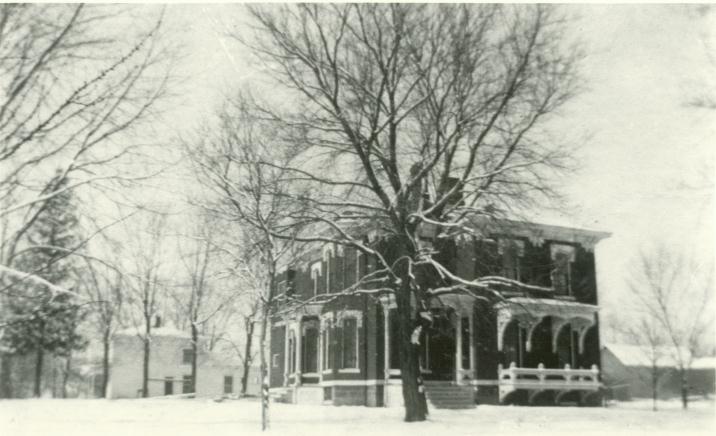
1908 photo of Tilden House
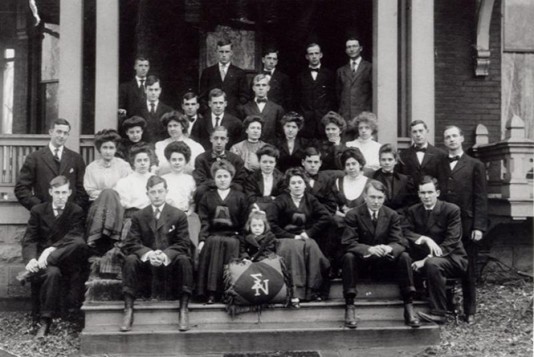
1910 photo. The little girl sitting in the front with the pillow is Lydia Tilden, granddaughter of Lydia and George Tilden and daughter of Ina and Galen Tilden.
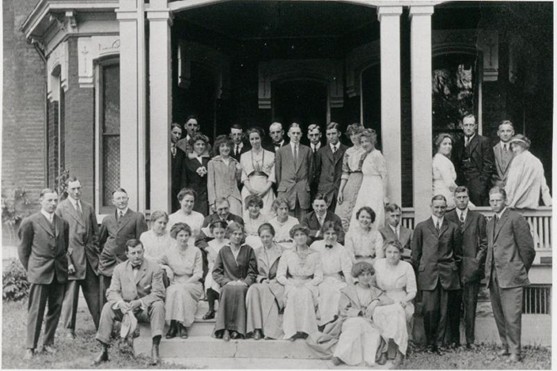
1913 photo. Galen Tilden (son of George and Lydia) is the third from the left in the second row and his wife Ina is the fourth from the left in the same row.
There is currently no house at the 1001 Douglas address and the house at 905 Douglas appears newer. Ames Public Library confirmed that the Tilden’s remodeled the house in 1918 from the original Italianate style to a Prairie style design. That is consistent with the appearance of the current house at this address. This would confirm that the first Gamma Sigma house was likely at the 905 Douglass location.
Whichever location is correct for the first Gamma Sigma house, the location near downtown Ames required the members to ride Dinky to campus. According to Ames historian Farwell Brown: “The Dinkey” for years was the principal method of transportation from downtown Ames to the campus (unless you had a horse and buggy). It was a steam-driven train started in 1891, operated until 1907. Emblazoned on the side of the “Dinkey” were the initials A & C RY (Ames & College Railway). It was replaced in 1907 by electric streetcars. And the railroad tracks continued down the middle of Main Street, west across the college pasture and through the campus to Knapp Street, until about 1929. But many folks, students and professors alike, walked from home to the campus on “the cinder path,” which paralleled the railroad tracks.
A number of fraternities and sororities resided in downtown Ames in those days. By 1920, expanding college activities and improved facilities in west Ames found most Greek societies moving to locations near the campus.
In 1913 they moved to a house at 2166 Lincoln Way. This house had been built in 1898-99 for Alfred A. Bennett, who moved to the house next door. This site is currently occupied by the Buchanan Residence Hall.
According to a January 6, 1916 article in the Ames Evening Times, Sigma Nu had 26 local members. The officers of the chapter at this time were O. J. Whittemore, president; J. D. Sweeney, house manager; R. C. Gibbs, steward; and Fred Wilson, treasurer.
This house burned down in 1923. Mysteriously the charter and much of the members’ property was not in the house when it burned.
In 1924 James Burrows (GS27) designed and led the building of the new house at 2132 Sunset Drive. The financing was provided by a banker who was a contemporary of Burrows’. Brother Burrows ran the house corporation for many years.
Sigma Nu was at ISU continuously from 1904 until 1996, except for a short time during WW II. The list of Gammas Sigma initiates shows just three members initiated in 1944 and one in 1945 indicating that the fraternity was not really active during the last couple years of WWII.
During the war, starting in 1943, many of the ISU fraternities, including Sigma Nu, were used as dormitories for female students, while military men occupied the womens’ dormitories.
The first Greek Week was held in Fall 1952.
There was an alleged sexual assault incident at the Sigma Nu house in 1994. No charges were filed. It involved an ISU coed who was under the age of 21 and was served alcohol in the house. The alcohol was paid for with a check from the chapter account.
As a result of this incident, Sigma Nu National put the chapter on probation for one year. In an inspection of the house during that period, beer keg apparatus was found. National did not handle the situation very well. As a result, all but five members moved out.
National revoked Gamma Sigma’s charter in October 1995.
That move was reported in a somewhat positive tone in an October 31, 1995 article in the Iowa State Daily:
Sigma Nu fraternity’s decision to become a dry house is good for the ISU Greek System. Beginning Jan. 1, 1996, ISU’s Sigma Nu chapter will no longer allow alcohol on its premises. The decision was made after the fraternity was suspended by Sigma Nu nationals for violating a risk reduction policy. Since Sigma Nu chapters nationwide will become dry by the year 2000, officials at the ISU chapter decided to implement the alcohol free policy a few years earlier than required. The fraternity joins Alpha Sigma Phi and FarmHouse as the third fraternity on campus that is considered to be dry. Sigma Nu offers another option to prospective Greek System members who are looking for alcohol free fraternities. Apparently, the option has been well-received. Alpha Sigma Phi has over 40 members, and FarmHouse has reached membership capacity. Sigma Nu’s decision to go dry reflects a national trend. By continuing the trend at ISU, Sigma Nu shows concern both for its chapter and for the ISU Greek System as a whole.
There was a brief effort to rebuild the chapter. Nineteen new members pledged, but the rebuild did not work out.
According to an article in the Iowa State Daily July 27, 1998:
Iowa State’s greek system will have one less fraternity next fall when the Sigma Nu chapter will no longer be active. The news came to members of the fraternity this spring when financial problems, low membership and lack of support from the national fraternity combined to bring the chapter to a close. “We tried to keep things quiet at first because [the house] had different reasons for closing than what happened three years ago,” said Jeff Irvin, senior in biology and fraternity president.
After losing its charter in October 1995, Sigma Nu, 2132 Sunset Dr., went “dry” to regain national support. Several active members worked with the national organization in an effort to recruit members and start over again, Irvin said.
However, Sigma Nu’s recent troubles stemmed strictly from low membership and the strong financial need rather than social problems. Irvin said the financial strain, as well as the fact that Sigma Nu was a dry house, contributed to the problem of low membership. “We had a strict rule that if a member was caught with alcohol, they had two weeks to leave,” Irvin said. “Also, the house was really in need of repair, from faulty electric wires to a delayed fire system. It’s easy to see why it was hard to get numbers up.” Schulz said several dry fraternities have had problems with numbers.
“I love the size of this house; we were all a very tight-knit group, especially after everything we’ve been through to keep the house going,” Irvin said.
The house corporation disintegrated, with six of the seven members deserting. This left Tyler Farner (GS1139) to fend for himself. He was faced with debts totaling over $200,000 and no source of income. Cause of those debts was never uncovered. In 1999, at the encouragement of National, Farner decided to sell the house at 2132 Sunset.
Communications to the alums about this situation and the decision to sell the house were almost non-existent. Frederick (Fritz) Raab (GS772) and Robert Thompson (GS789) heard about the situation and started asking questions. It was not clear if the current house corporation had any bylaws or other official structure. However with the excessive debt they were not in position to change the course of things. The house was sold.
After the sale Farner turned everything over to Raab and Thompson. That same year Raab and Richard Scheffler (GS759) drafted new bylaws They had these approved by National, then by the alums, and then elected a board. The new group of board members were Raab, Scheffler, Thompson, Richard Winchester (GS384), Steven Hill (GS797), Dean Kruse (GS807), and Jason Gammack (GS1112). This new SNHC, also functioning as Gamma Sigma Alumni Association, put the closed chapter’s financial affairs in order (bills, taxes, capital gains) and updated the Articles of Incorporation on file with the Iowa Secretary of State. They started publishing newsletters and held reunions, looking ahead to trying to recolonize the chapter.
A number of Gamma Sigma alumni reunions were held from 2003 to 2010. In October 2004, a reunion was held on campus to celebrate the chapter’s centenary. Another alumni reunion, the White Rose Informal, was held in September 2006.
In 2009 a recolonization effort began.
An Iowa State Daily article on October 21, 2009 reported:
Eleven years after the Sigma Nu fraternity closed at Iowa State, 30 men have pledged to revive the chapter and start a new beginning based on old traditions. The Sigma Nu chapter was one of the oldest fraternities on campus, chartered in 1904. The undergraduate chapter has been inactive since 1998 following a series of setbacks. However, starting in spring 2010, the fraternity will once again be part of the ISU greek community. Brandon Werner, president of Sigma Nu and sophomore in agriculture and life sciences education, said that what happened to the chapter is in the past and they have a chance to re-create the image of Sigma Nu. “It’s what we do now that people will remember,” he said. Meeks has led the process of recruiting new members and organizing the chapter. He said the difference between the old fraternity that was closed and the new one that is being developed is that now “members are committed for the right reasons.” The 30 new members of Sigma Nu are of all ages and backgrounds. Meeks said the most important thing during the process was to recruit men who will help build the best fraternity on campus. Meeks said he focused on certain attributes while talking with potential new members. These included having a positive attitude, being academically strong as well as out-going and having a strong sense of values and ethics. “I look for men who want to expand their social network and get involved,” he said. “Someone who lives by what he believes in and is connected to the values of the chapter.” Jeffrey Roloff, vice president of Sigma Nu and sophomore in pre-business, was in the military for two years. He said that what attracted him to Sigma Nu was that the chapter shares a lot of the same ideas as the military regarding honor and responsibility. “What separates [Sigma Nu] from other fraternities is that it’s still really true to the values it was founded upon,” Roloff said. The values of Sigma Nu are love, truth and honor. The fraternity alumni have also been responsible for the organization of the chapter and making sure these values of love, truth and honor, are upheld. They act as mentors and advisers to the undergraduates. When meeting with alumni, Werner said some of them got emotional when talking about Sigma Nu coming back to Iowa State. He said the chapter really means a lot to them. The chapter does not have a house yet, but the Alumni Association is hoping to buy one within the next couple years. “Our focus right now is building a fraternity,” Meeks said. “While having a house is important, our focus is building the brotherhood.” The members instead meet on campus twice a week. These meetings include fraternity education, as well as learning how to run a fraternity. “All the members are new,” Meeks said. “They get the chance to be a leader right away.” Officers for the chapter have already been elected. “My duty [as president] is to be the face of the chapter and lead by example,” Werner said. He runs the meetings, assigns committees and is “generally a liaison to the university, alumni and other chapters.” “I was very proud to be elected as president…I wanted the opportunity to work with 29 other guys and build something great. [Sigma Nu] is what I believe a fraternity should be,” Werner said. Roloff agreed. “I like that we can start a fraternity how we want it to be, not just join something that’s already there,” he said. The primary goal of the chapter is to get its charter back, so it can be officially recognized as a fraternity at Iowa State. The members are also focused on “Building a Rock Chapter,” which is the fraternity expansion motto, according to the Sigma Nu Web site. A “rock chapter” is an award given to the Sigma Nu chapters recognized as most prestigious in the country. It is the goal of the ISU chapter to receive this highest honor award. Right now, Meeks said, they are currently focused on the short term, concentrating on preparing and organizing the fraternity. However, he said, next semester Sigma Nu will be more involved with the greek community by participating in activities such as Greek Week and lip sync and attending philanthropies. Werner said he sees the future of Sigma Nu as being one of the strongest fraternities on campus, a leader in academics and involved within the greek community as well as on campus. He said he hopes they can become what other chapters aspire to be.
The House Corporation members at this time were Raab, Dan Simpson (GS520), Shawn Ovenden (GS1109), Joel Thorpe (GS762), Craig Adamson (GS1142), Chris Swailes (GS1129), and Marshall Wilharm (GS771). The Alumni Advisory Board consisted of Dave North (GS1101), Farner, Justin Sample (GS1156), Adamson, and Swailes.
The recolonization effort failed in 2013. A post-mortem determined that some of the causes of failure were lack of planning for a means of addressing problems in the colony, a lack of alumni involvement, no resident advisor, no common housing (a house), and weak support from National.
In 2018 Frank Sherman (GS784) was president of the SNHC. Under his leadership the board began looking into the possibility of another recolonization attempt.
Traditions & Practices:
Another important part of our history are the annual – or at least very frequent events – that took place over the course of the school year.
- One such event was the “Sod Busters Ball” that was held nearly every fall since before World War II.
- Another event was the annual “Orchid” or “White Rose” formal dance.
- Many will remember the popular Sigma Nu relays, which were eventually banned by the university. (Mud pits were not deemed appropriate for ISU coeds).
- Most of us remember working on a lawn display or float at a frantic pace because the start of Homecoming or the Veishea parade was just hours away.
- We also look back on earning our way into the fraternity through pledge duties and projects, culminating in initiation and the privilege of burning our names into tabletops. Roommates are remembered – for better or worse – but somehow we all got along and made it work. Gamma Sigma was an important part of learning to work with others as part of a team and learning to take responsibility as young adults.
- From the 1960’s forward, actives “owned” a room, usually two brothers, who then lived in that room for the duration of their time in the house. Pledges rotated among rooms every quarter.